
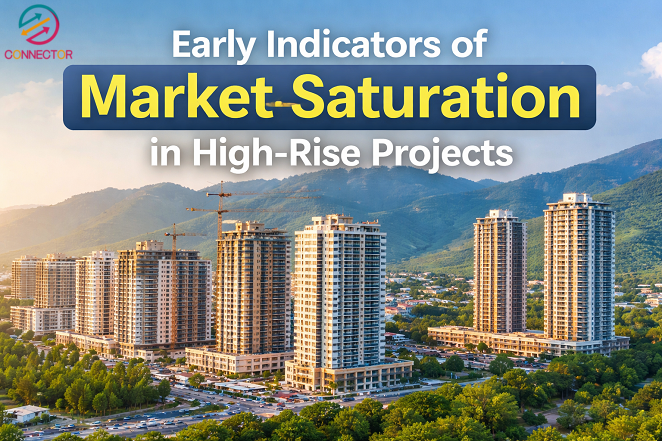
High-rise apartment projects are expanding quickly across Pakistan. Islamabad is at the center of this growth. Areas such as B-17, DHA, Gulberg Greens, and main urban corridors show constant new launches.
High-rise living attracts investors, overseas Pakistanis, and end users. But rapid development increases risk. One major risk is market saturation in high-rise projects.
Market saturation occurs when apartment supply exceeds real housing demand. When this happens, price growth slows, rental income weakens, and investment risk increases.
This guide explains the early indicators of market saturation in Islamabad and Pakistan. These indicators help investors, buyers, and developers make informed decisions.
Understanding Market Saturation in Pakistan’s High-Rise Real Estate
Market saturation means excessive supply in a defined real estate market. Demand is unable to absorb available units within a reasonable time.
In Islamabad, high-rise projects are often concentrated in limited zones. These zones attract similar buyer profiles. Most buyers seek mid-range apartments for investment or rental income.
When supply grows faster than end-user demand, the apartment market becomes imbalanced. This imbalance creates pressure on prices and rental yields.
Why Early Saturation Indicators Matter in Islamabad
Islamabad is considered a safe real estate market in Pakistan. Many investors expect steady appreciation. When saturation begins, appreciation slows first. Rental demand weakens next. Exit opportunities become limited.
Identifying early indicators protects capital. It helps investors avoid overvalued projects and long holding periods.
Rapid Growth in High-Rise Project Approvals
A major indicator of saturation is excessive project approval.
In Islamabad, multiple high-rise approvals often occur within the same sector or zone. Population growth does not increase at the same pace.
This creates artificial supply. Investor-driven launches replace genuine housing demand. Over time, absorption capacity weakens.
Slowing Apartment Sales Velocity in Islamabad
Sales velocity reflects buyer demand strength. In balanced markets, apartments sell consistently after launch. In saturated markets, sales slow down.
In Islamabad, extended booking timelines and unsold inventory indicate reduced buyer confidence. Projects rely more on installment buyers rather than end users.
Slow sales velocity is a direct signal of high-rise market saturation.
Rising Vacancy Rates in Completed High-Rise Buildings
Vacancy rate is a strong saturation indicator. Completed apartment buildings in Islamabad often show empty units. Rental listings increase on property portals. Units remain vacant longer. Tenants have more options. Rental negotiation power shifts to tenants.
High vacancy weakens rental income and lowers property value stability.
Increased Use of Discounts and Flexible Payment Plans
- Developers respond to weak demand with incentives.
- In Islamabad, extended installment plans, booking discounts, and price reductions are becoming common.
- In strong demand markets, such incentives are unnecessary. Their presence indicates supply pressure.
- Frequent discounts signal early saturation in the high-rise apartment market.
Declining Rental Yields in Islamabad High-Rise Projects
- Rental yield reflects investment health.
- In saturated Islamabad markets, apartment prices rise faster than rental rates. This compresses yield.
- Low rental returns reduce investor interest. Holding costs increase due to maintenance and service charges.
- Declining yield confirms supply-demand imbalance.
Repetitive Apartment Designs and Limited Product Differentiation
Many Islamabad high-rise projects share similar layouts. Unit sizes repeat. Amenities overlap. Buyers struggle to see value differences. Competition increases between similar projects. Lack of differentiation reduces buyer urgency and slows market absorption.
Broader Market Signals of High-Rise Saturation in Pakistan
Marketing expenditure increases while conversion rates decline. Launch events attract fewer serious buyers. Developers rely heavily on overseas investors and speculative demand.
Online listings grow faster than actual transactions. These signals reinforce saturation risk.
Impact of Market Saturation on High-Rise Investors
Price appreciation slows down first. Resale timelines extend. Rental income becomes unstable. Vacancy risk increases. Investors face longer holding periods. Liquidity reduces. Exit requires price adjustments. Saturation increases financial exposure for apartment investors.
Developer-Level Warning Signs in Islamabad
- Construction schedules extend without clear justification.
- New phases launch before existing inventory sells.
- Marketing promises increase. Amenities are overstated to attract buyers.
- These behaviors indicate demand pressure and oversupply risk.
How to Avoid Saturated High-Rise Markets in Islamabad
- Analyze absorption rates and approved supply data.
- Compare vacancy levels in nearby completed projects.
- Study rental demand near offices, universities, and transport routes.
- Focus on projects with location utility, not marketing hype.
- Data-driven analysis reduces investment risk in Islamabad real estate.
Observations From Saturated High-Rise Zones in Pakistan
Oversupplied areas show flat price movement over time. Generic projects underperform. Well-located projects retain demand. Experienced investors shift early. They prioritize demand-driven developments.
Market experience confirms the importance of early saturation indicators.
Future Outlook for High-Rise Development in Islamabad
- High-rise demand will continue in Islamabad due to urban growth.
- However, unchecked supply expansion will face resistance.
- Regulatory control and buyer awareness will increase.
- Projects aligned with real housing demand will perform better.
Conclusion
Early indicators of market saturation in high-rise projects are visible in Islamabad and Pakistan. Rapid approvals, slow sales velocity, rising vacancy rates, declining rental yields, and aggressive incentives all signal risk.
Investors must analyze these indicators before committing capital. High-rise investments succeed when supply matches real demand.
Informed decisions ensure long-term stability and returns.