
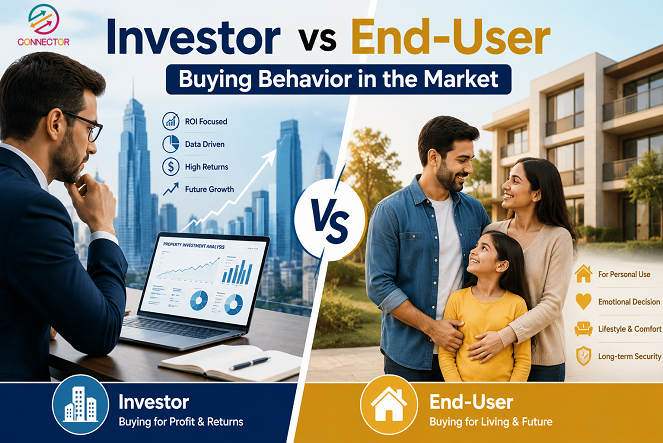
Every property market has two types of buyers. One buys to live. The other buys to earn.
Both groups are active in Pakistan right now. Both are competing for the same properties. But they think very differently. They look at different things. They make decisions in different ways. And they respond to market changes in opposite directions.
Understanding these two buyer types is not just useful for real estate agents. It matters for anyone who wants to buy, sell, or invest in property. If you know how each group behaves, you can read the market better. You can make smarter decisions. And you can avoid costly mistakes.
This guide breaks it all down. We explain who investors and end-users are. We compare how they think. We look at how their behavior moves prices. And we show how both types can find real value in the current Pakistani market, including in emerging communities like Valencia Heights B-17 in Islamabad.
Who Are Investors and End-Users?
Before comparing buying behavior, it helps to define each type clearly.
The End-User
An end-user is someone who buys a property to live in it. They plan to make it their home. They think about how the property fits their daily life. They think about safety, comfort, schools, hospitals, and neighborhood quality.
End-users are not buying for profit on paper. They are buying for something real and personal. But here is a common mistake people make. Many assume end-users are not thinking about money. That is wrong.
When a family in Islamabad takes out a home loan and commits to years of EMI payments, they are making a serious financial decision. They expect the property to hold or grow in value. They want a safe asset for their future. So end-users are also investors in a sense. Their approach is just different.
The Investor
An investor buys property to earn from it. The goal is either rental income, capital appreciation, or both. Investors are not looking for a home. They are looking for returns.
Investors come in several types. Some are individuals who buy one or two units to rent out. Some are small groups pooling money together. And some are large institutional buyers, like funds or corporations, buying many units at once.
Each type of investor behaves slightly differently. But they all share one core trait: the buying decision is based on numbers, not feelings.
Key Insight: Both investors and end-users want value from their purchase. The difference is in how they define value.
Quick Comparison: Investor vs End-User
| Factor | Investor | End-User |
| Primary Goal | Rental income or capital gain | A safe, comfortable home to live in |
| Time Horizon | 2 to 10 years depending on strategy | 10 to 25 years or lifetime |
| Location Priority | Yield zones, early-stage areas | Schools, hospitals, daily amenities |
| Renovation Style | Minimal and utilitarian | Personal, detailed, pride-driven |
| Decision Driver | ROI, yield, price growth data | Emotion, family needs, liveability |
| Selling Behavior | Sells when returns are achieved | Sells after long occupancy with liveability proof |
How Each Type Makes a Buying Decision
The buying process looks very different for each group. From location to timing to financing, almost every step works differently. Here is a detailed look at each key factor.
Location
For end-users, location is personal. They want to be close to good schools for their children. They want access to hospitals, markets, and mosques. They want a neighborhood that feels safe. They want to know their neighbors.
For investors, location is about numbers. They look at areas with strong rental demand. They look for zones where prices are rising. They often target early-stage developments where they can buy at a low price and sell later at a premium.
Valencia Heights B-17 in Islamabad is a strong example of a location that works for both groups. For end-users, it offers planned infrastructure, gated community living, and proximity to key parts of Islamabad. For investors, B-17 is an area with strong price growth momentum and growing rental demand as the sector develops.
Property Stage
End-users usually prefer ready-to-move-in properties. If they are currently renting, they cannot afford to pay both rent and EMI at the same time. A completed property solves that problem immediately.
Investors think differently. They often prefer under-construction or pre-launch properties. These come at lower prices. By the time the property is ready, the price has gone up. That gap is the profit.
This difference in preference often creates a healthy market balance. Investors fund early-stage projects. End-users then buy completed units at market rate. Both groups play a role in keeping the market moving.
Renovation and Presentation
When an end-user renovates a home, they make it personal. They choose finishes that reflect their taste. They invest in quality because they will live there every day. They care about every detail because it is their space.
An investor renovates differently. The goal is to make the property rentable, not beautiful. Renovations are minimal. Materials are standard. The work is done to meet tenant expectations, not personal preferences.
This difference has an interesting effect on resale value. When an end-user eventually sells their home, the buyer knows the property was lived in with care. That history carries trust. It is proof that the location worked for a real family. Properties like this often command a premium.
Time Horizon
End-users think in decades. They buy a home and plan to stay for many years. They are not watching the market daily. They are not waiting for the right moment to exit. Their relationship with the property is long-term.
Investors must think carefully about timing. A short-term investor may hold a property for two to five years and then flip it. A long-term investor may hold for ten years while collecting rent. The decision depends on market conditions and financial goals.
Real estate markets move in cycles. These cycles usually include four stages: expansion, hypersupply, recession, and recovery. Investors who understand these cycles time their entry and exit better. End-users are less affected by cycles because they are not planning to sell soon.
Financing
Most end-users in Pakistan rely on home loans. Their budget is defined by the EMI they can afford each month. They look for properties that fit within that range. The financing ceiling is set by their income.
Investors calculate differently. They compare rental yield against carrying costs. They think about mortgage payments, property taxes, maintenance, and vacancy risk. They want the numbers to work even in a slow month. Cash investors think about opportunity cost. Could this capital earn more somewhere else?
The Psychology Behind Each Buyer Type
Behavior is not just about logic. It is also about how people think and feel. Understanding the psychological side of buying explains a lot about what happens in the market.
End-User Psychology
Buying a home is emotional. For most families, it is one of the biggest decisions of their lives. It carries hope, pride, and excitement. End-users respond to how a property feels. Is it welcoming? Does it feel safe? Can they picture their life here?
This emotional connection is not a weakness. It often leads to better choices. End-users tend to pick properties in truly liveable areas. They avoid poorly planned developments. They stay away from locations that feel wrong, even if the price looks good. Over time, their choices often prove correct.
Investor Psychology
Investors try to remove emotion from the process. They focus on data. They look at price trends, rental demand, yield calculations, and area development plans. But investors are not perfectly rational either.
Research shows that investors tend to buy more during periods of high media attention. When a neighborhood gets news coverage or social media buzz, investor activity increases. This is called attention-driven buying. It can push prices up quickly in a short period.
Investors also show herding behavior. When one investor buys in an area, others follow. This creates momentum that can inflate prices beyond what the fundamentals support.
Behavioral Biases That Affect Both Groups
Both investors and end-users are affected by common psychological biases. Three are especially important in property markets.
Anchoring: Buyers often fix on a number and judge everything against it. A seller who paid a certain price will anchor to that number even if the market has moved. A buyer who sees an early price quote will anchor to it even if conditions have changed.
Loss aversion: People hate losing more than they love winning. A homeowner whose property has dropped in value will often refuse to sell, waiting for the price to recover. This keeps supply low and can slow market correction.
Herding: As mentioned above, both buyers and investors follow each other. In rising markets, this creates fast price growth. In falling markets, it can trigger sharp declines.
Knowing these biases does not eliminate them. But it helps you pause and ask: am I making this decision based on real data, or am I following the crowd?
How Investor and End-User Behavior Shapes Market Prices
The combined behavior of these two buyer types directly shapes property prices across Pakistan.
How Investors Affect Supply
When investors buy properties to hold as rentals, they remove those units from the market for sale. This reduces supply for end-users. When supply falls and demand stays the same, prices rise.
This effect is visible in high-growth areas. As investor activity increases in a neighborhood, prices go up. End-users face more competition. They often find themselves outbid or priced out of their preferred areas.
But the reverse also happens. When investors pull back, perhaps because interest rates rise or returns fall, they often sell their holdings. This adds supply back to the market. Prices stabilize or drop. End-users get more options at better prices.
How End-Users Affect Supply
End-users also affect supply in an interesting way. When mortgage rates are high, many homeowners choose not to sell. They do not want to buy a new property at a higher rate than their current loan. This is called the lock-in effect.
The lock-in effect reduces available inventory. It means fewer properties are listed for sale. In markets where this is strong, prices stay elevated even when affordability is low. Pakistan’s urban markets have seen similar dynamics as financing conditions shift.
The Role of Institutional Investors
Large institutional buyers play a stabilizing role in some markets. When overall home sales slow down, institutional investors sometimes step in and buy more. They provide liquidity that keeps the market from collapsing.
This is a complex dynamic. On one hand, institutional activity can support prices during downturns. On the other hand, when concentrated in a single area, large investors can push prices beyond what ordinary families can afford.
Foreign Investors and Premium Segments
In Pakistan, overseas Pakistanis are a significant investor group. They often target premium and gated community properties. Their willingness to pay at market or above-market prices inflates values in the premium segment.
This creates a two-speed market. Premium properties see strong demand from overseas buyers. Mid-range properties serve the local end-user market. Understanding which segment you are operating in helps you read price movements more accurately.
What This Means for Buyers in Pakistan: The Case of Valencia Heights B-17, Islamabad
Pakistan’s property market is growing rapidly. Cities like Islamabad, Lahore, and Karachi are all seeing strong demand from both investors and end-users. Each city has its own dynamics. But the behavioral patterns described in this guide apply across all of them.
Islamabad in particular has become a market where investor and end-user demand meet. The city’s planned development, stable governance, and strong infrastructure make it a target for both groups.
Within Islamabad, the B-17 sector has emerged as one of the most active growth corridors. And within B-17, Valencia Heights stands out as a development that genuinely serves both buyer types.
For End-Users at Valencia Heights B-17
Families looking for a permanent home find Valencia Heights B-17 to be a compelling choice. The community offers gated living, planned open spaces, and access to key Islamabad locations. The infrastructure supports daily life. Schools, healthcare, and markets are accessible from the area.
For end-users, the key question is always: will I be comfortable here for the next ten to twenty years? Valencia Heights B-17 answers that question well. It is planned, maintained, and positioned within a sector that is clearly developing into a mature residential zone.
End-users who buy here get more than a home. They get proof of future value. When an area develops well around a property, resale prices reflect that growth. A family that buys now is locking in a price before the area reaches full maturity.
For Investors at Valencia Heights B-17
Investors look at Valencia Heights B-17 from a completely different angle. The question is not about comfort. It is about return.
B-17 has shown consistent price appreciation over recent years. As Islamabad expands and the demand for quality housing increases, areas like B-17 benefit from organic price growth. Valencia Heights sits within that growth corridor. Investors who entered this market early have already seen strong capital gains.
On the rental side, the demand for gated community housing in Islamabad is growing. Young professionals and families seeking a secure and comfortable environment are increasingly choosing such communities. This creates a steady rental demand that investors can rely on.
The balanced appeal of Valencia Heights B-17 is what makes it rare in the Pakistani market. It attracts end-users because it is genuinely liveable. It attracts investors because it delivers real returns. Both buyer types create competition for units, which supports long-term price stability.
Who Benefits More: Investor or End-User?
This is one of the most common questions in real estate. The honest answer is: it depends on the market conditions at the time.
When Investors Win
In fast-moving, early-stage markets, investors tend to benefit more. They enter at low prices, hold through the growth phase, and exit with strong returns. They can also diversify across multiple properties, spreading risk. And they generate income while waiting for the market to rise.
Investors who understand market cycles gain a significant edge. They do not panic when prices dip. They see downturns as entry opportunities. This disciplined approach produces strong long-term results.
When End-Users Win
In stable, mature, high-quality markets, end-users often do just as well. A property that has been lived in and cared for carries a special kind of value. When end-users sell after years of occupancy, they are offering buyers something an investor property cannot: proof of liveability.
Buyers pay a premium for this. They trust a home more when they know a real family lived there happily for many years. This effect is especially strong in well-planned communities where quality of life is central to the product.
Additionally, end-users avoid many of the risks investors face. They do not worry about vacancy. They do not manage tenants. They do not lose sleep over short-term price drops. Their home serves them regardless of what the market does.
The Practical Answer
The smartest approach is to understand your own situation clearly. Ask yourself these questions before buying.
- Are you planning to live in this property, or do you want financial returns?
- How long can you hold the property before you need to sell?
- Can you afford to carry the property through a slow market period?
- What does the surrounding area look like in five to ten years?
- Is the property in a location where demand from both investors and end-users is growing?
If your answers point to personal use and long-term holding, you are an end-user. Focus on liveability and location quality. If your answers point to returns and exit planning, you are an investor. Focus on yield, timing, and market cycles.
Many buyers in Pakistan sit somewhere in the middle. They want a home they can live in now and sell at a profit later. This hybrid approach works well in markets like B-17 Islamabad where both liveability and investment growth are genuinely present.
Market Trends Shaping Both Buyer Groups in Pakistan (2025 to 2026)
The Pakistani property market is going through a period of change. Several trends are reshaping how investors and end-users behave. Knowing these trends helps you stay ahead.
Interest Rate Sensitivity
When borrowing costs rise, end-users feel the pressure first. Higher rates mean higher EMI payments. Many families delay purchases or lower their budget. Investors who use cash are less affected. This shifts competitive dynamics in the market.
As interest rates stabilize or drop, end-user demand tends to come back strongly. Markets that experienced slowdowns during high-rate periods often see sharp recoveries when financing becomes easier. Islamabad’s property market has historically followed this pattern.
Technology and Market Information
Both investors and end-users now have access to far better market data than before. Online portals, micro-market analysis tools, and digital property listings have reduced information gaps. This means buyers can make smarter decisions faster.
For investors, better data means more disciplined entry and exit decisions. For end-users, it means the ability to compare areas, understand price trends, and negotiate with confidence. Overall, this trend improves market efficiency.
Generational Shifts in Demand
Younger Pakistanis are entering the housing market in larger numbers. Many want gated communities with good infrastructure, secure environments, and modern facilities. This demographic shift is driving demand for exactly the kind of development that Valencia Heights B-17 represents.
At the same time, older buyers are beginning to downsize. They are selling larger family homes and moving to well-managed, lower-maintenance communities. This adds supply in some segments while increasing demand in others.
Sustainability and Climate Awareness
Buyers are increasingly thinking about environmental risk. Flood zones, water access, air quality, and energy efficiency are now factors in buying decisions. Properties in well-planned areas with proper drainage, water supply, and green spaces score better with both investors and end-users.
This is another reason why planned developments in sectors like B-17 attract consistent demand. Infrastructure planning reduces environmental risk. That stability is attractive to both buyer types.
Conclusion
Investor and end-user buying behavior shape every market in different and often opposite ways. Investors chase returns. End-users seek liveability. But both groups are looking for real value. And both groups respond to the same market forces, just through different lenses.
Understanding both types of buyers gives you a real advantage. If you are a buyer, you know how to position yourself. If you are a seller, you know how to present your property to the right audience. If you are an agent or developer, you know how to design and market for the right demand.
In Pakistan, the property market is maturing quickly. Islamabad, and specifically areas like B-17, represent the next phase of high-quality residential development. Valencia Heights B-17 is one of those rare projects that speaks to both buyer types authentically. It offers the liveability that end-users need and the growth potential that investors seek.
Whether you are buying to live or buying to earn, knowing your own buyer profile and understanding the behavior of the market around you is the foundation of a smart decision.
Frequently Asked Questions
| Question | Short Answer |
| Who is an end-user? | Someone who buys a property to live in it, not to earn from it. |
| Who is a property investor? | Someone who buys to earn rental income or profit from price appreciation. |
| Do investors raise prices? | Yes. When investors buy in large numbers, they reduce supply for end-users and push prices up. |
| Which buyer type is smarter? | Neither. Each type wins in different conditions. Liveability focus often brings better resale too. |
| Is Valencia Heights B-17 for investors or end-users? | Both. Its location, liveability, and capital growth potential make it attractive for each type. |
Which Type of Buyer Are You? A Quick Checklist
Answer these five questions honestly. Your answers will help you identify your buyer profile and guide your approach.
1. Are you planning to live in the property?
If yes, lean toward end-user priorities: liveability, location quality, and long-term comfort.
2. Do you need rental income from the property?
If yes, think like an investor: calculate yield, check tenant demand, and assess the area’s rental market.
3. How long can you hold without needing to sell?
Short-term holders need strong growth markets. Long-term holders have more flexibility and often end up with the best outcomes.
4. Are you willing to manage tenants and property maintenance?
If not, buying for personal use is a much smoother experience.
5. Is your primary goal financial growth or quality of life?
Financial growth points to investor strategy. Quality of life points to end-user strategy. Many buyers want both, and that is perfectly fine.
Properties like Valencia Heights B-17 in Islamabad are well-positioned for buyers who want both outcomes. Strong liveability meets strong capital growth in a single location.